White Paper
The Boutique Advantage
Why Discerning Clients Choose Specialized Advisory
Why Discerning Clients Choose Specialized Advisory
The advisory landscape is undergoing a fundamental shift. As business challenges grow more complex and specialized, a growing number of sophisticated clients are reconsidering the traditional preference for large, global consultancies. This white paper examines the structural advantages of boutique advisory firms and provides a framework for determining when specialized advisory delivers superior outcomes.
Our analysis draws on extensive advisory experience across global growth markets, supplemented by research into client satisfaction patterns and outcome metrics across different advisory models. The conclusion is clear: for clients facing complex, relationship-dependent challenges, boutique advisory often delivers meaningfully better results than enterprise alternatives.
The management consulting industry has historically been dominated by a small number of global firms offering broad-spectrum advisory services. This model made sense in an era when information was scarce, geographic reach was limited, and standardized frameworks could be applied across industries with minor modifications.
That era is ending. Several forces are reshaping the advisory landscape:
Large advisory firms face structural constraints that limit their effectiveness for certain client needs:
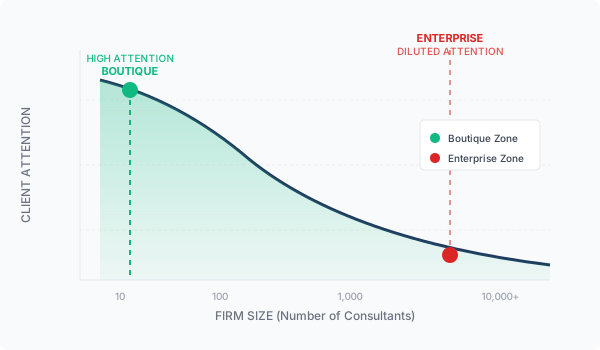
As advisory firms scale, individual client attention necessarily decreases. Boutique firms occupy a different position on this curve.
The economics of large consultancies require high utilization rates, standardized deliverables, and leverage models that deploy junior resources on client work. These structures are efficient for certain types of engagements but create inherent limitations for relationship-intensive advisory.
Boutique advisory firms operate under fundamentally different economics and incentives than their larger counterparts. Understanding these differences illuminates when and why boutique advisory delivers superior outcomes.
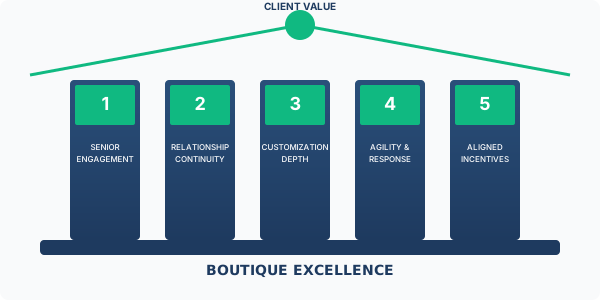
In boutique firms, senior advisors don't just sell work—they deliver it. This creates several advantages:
Large firms rotate staff across clients based on utilization needs. Boutique firms maintain relationship continuity, creating compounding benefits:
Boutique advisors have both the time and incentive to deeply customize their approach. Without the pressure to apply standardized frameworks, solutions can be genuinely tailored to specific situations.
This matters most for challenges that don't fit neatly into established categories—which, increasingly, describes most strategic challenges worth advisory investment.
Without bureaucratic approval processes, boutique advisors can respond rapidly to changing circumstances. When markets shift or new information emerges, strategies can adapt in real-time rather than waiting for formal change management processes.
Boutique firm economics create natural alignment with client outcomes:
Boutique advisory is not universally superior. Certain engagement types favor enterprise firms. The key is matching advisory model to engagement characteristics.
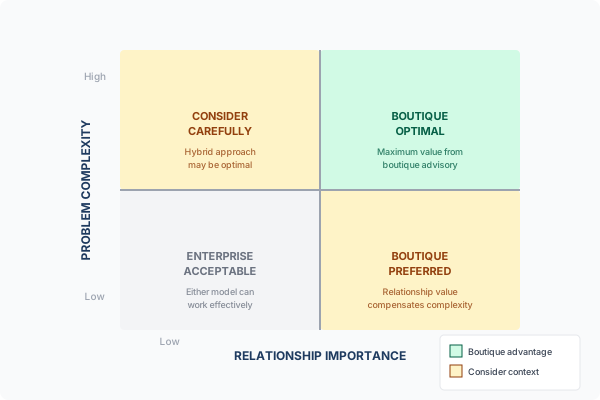
Plot your engagement needs to identify optimal advisory model.
Strategic decisions with high ambiguity: When the path forward is unclear and requires judgment rather than analysis, senior boutique advisors provide value that cannot be replicated by junior teams following frameworks.
Relationship-intensive engagements: Cross-border transactions, partnership negotiations, and situations requiring trust-building benefit from advisor continuity and personal investment.
Ongoing strategic counsel: For clients seeking a trusted advisor relationship rather than project-based work, boutique firms provide the sustained attention that relationship depth requires.
Situations requiring candor: When honest, potentially uncomfortable feedback is needed, advisors with long-term relationship stakes are better positioned to deliver it.
Large-scale implementations: When execution requires hundreds of consultants across multiple geographies, scale is genuinely necessary.
Regulatory or audit requirements: Some situations require the credibility and coverage of recognized global firms.
Standardized transformations: Well-defined programs with established playbooks can be efficiently delivered through leverage models.
Our methodology embodies boutique principles while incorporating the rigor that complex advisory demands. This chapter outlines how we translate boutique advantages into client outcomes.
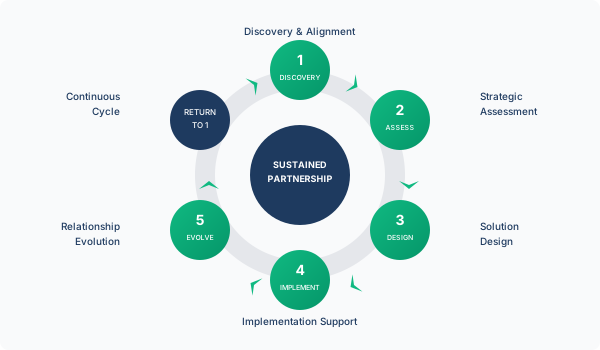
Unlike project-based engagements that follow a linear path, boutique advisory follows a cyclical model where each phase informs and enriches the next. This creates compounding value over time.
Before any advisory work begins, we invest significant time understanding context. This includes:
This investment pays dividends throughout the relationship, enabling nuanced advice that accounts for factors that surface-level analysis would miss.
With context established, we conduct rigorous analysis of the specific challenge at hand. Our assessment approach combines:
We co-create strategies with clients rather than presenting recommendations for approval. This collaborative approach ensures:
Strategy without execution support is merely an expensive report. We remain engaged through implementation, providing:
The most valuable advisory relationships don't end when projects complete. Sustained partnership provides:
Traditional advisory metrics focus on deliverables and billable hours. These measures capture activity but miss impact. Meaningful advisory measurement requires different approaches.

1. Decision Quality
Did advisory input improve the quality of decisions made? This includes both decisions taken and decisions avoided. Sometimes the greatest value comes from preventing costly mistakes.
2. Execution Effectiveness
Did advisory support improve execution outcomes? Better strategies fail without effective implementation. Advisory value must include execution impact.
3. Capability Building
Did the engagement leave the client better positioned to handle future challenges? The best advisory builds client capability rather than creating dependency.
Boutique advisory relationships demonstrate compounding value over time. As advisors develop deeper context understanding, the efficiency and effectiveness of counsel improves. Early investments in relationship building pay dividends across all subsequent interactions.
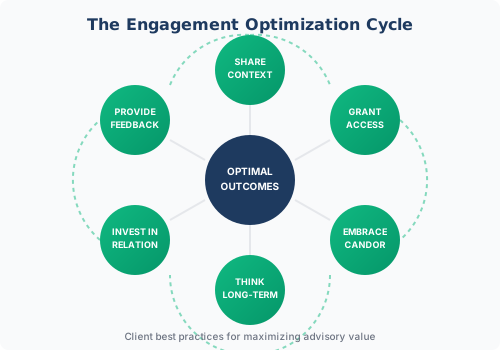
Clients can significantly influence advisory outcomes through their engagement approach:
1. Invest in Relationship Building
Take time to share context beyond the immediate engagement. Help your advisor understand your organization, culture, and history. This investment pays dividends in advice quality.
2. Create Access to Information
Advisors can only work with the information available to them. Provide access to data, people, and perspectives that inform better counsel.
3. Embrace Candor
Invite honest feedback and demonstrate that you can receive difficult messages constructively. Advisors who fear relationship consequences will soften their counsel.
4. Think Long-term
Evaluate advisory relationships on long-term value rather than individual engagement satisfaction. The most valuable relationships often include uncomfortable moments that precede breakthrough insights.
The advisory industry is at an inflection point. As artificial intelligence commoditizes analytical work and information asymmetries continue to erode, the value of genuine expertise, judgment, and relationships will only increase.
Boutique firms are uniquely positioned to deliver this value. Free from the scale imperatives that drive large consultancies toward standardization and leverage, boutique advisors can focus on what matters most: understanding clients deeply, providing counsel shaped by experience and judgment, and maintaining the sustained relationships that enable compounding value over time.
This doesn't mean large firms will become irrelevant. For certain engagement types, scale remains valuable. But for clients facing complex, relationship-dependent challenges—the challenges that matter most strategically—boutique advisory offers structural advantages that enterprise alternatives cannot match.
The question for discerning clients is not whether to engage advisory support, but how to select advisory partners aligned with their specific needs. We hope this paper provides a useful framework for that selection.
Blue Ridge Advisory is a boutique strategic advisory firm serving founders, investors, and funds across global growth markets. Based in the UAE with deep connections across Europe, the GCC, and Southeast Asia, we provide the dedicated attention and tailored strategies that only a boutique firm can deliver.
Our practice areas include startup growth advisory, investor advisory, and fund portfolio advisory. We work with a deliberately limited number of clients, ensuring the relationship depth and senior attention that distinguish boutique advisory.
To learn more about how our approach might align with your needs, we welcome a conversation.
We'd welcome the opportunity to discuss how boutique advisory might serve your specific situation.
Schedule a ConsultationGet the complete PDF with all frameworks and charts.
Request PDF CopyContact us to receive the full PDF with frameworks and charts.